The staggering commercial success of the original Doom turned the id Software parking lot into a de facto Ferrari dealership, and arguably bent the trajectory of the games business back towards the West from Japan. What followed in its wake were the first (now ubiquitous) 3D graphics cards, the rise of the (now dominant) FPS genre and a look and feel that approached Hollywood’s biggest blockbusters. But Doom was unique for another reason: it was customizable.
It’s now accepted as axiomatic that when any kind
of PC game emerges in a form that can be modified,
the time between its release and the emergence of a
Star Wars mod can be counted in weeks rather
than months. Doom’s engine was the first to
facilitate such mass-tinkering. The relative ease of
customizing the appearance of the in-game graphics
and the ability for those sufficiently adept and
motivated to create their own levels made it the
perfect host for any number of nerd and pop culture
fantasies. All that was needed were the right
cinematic stem cells (some art, the right sound
effects) to grow something completely new, and
because these creations were shared for free,
copyright law couldn’t touch them. One of the best
mods of this early era – and certainly the most
talked about – had nothing to do with Star Wars,
though.
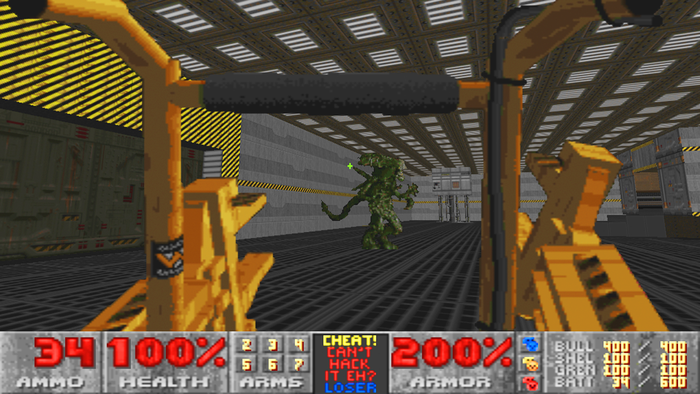
James Cameron’s Aliens was a major influence on id Software and was even touted early on as a possible setting for their follow up to Wolfenstein 3D. The flickering lights, dark, labyrinthine corridors, overwhelming odds and a hostile, isolated planet made it a perfect genetic match for Doom. Within a year of the game’s 1993 release, a number of Aliens-themed mods emerged, and the best-remembered today was one by a young New Zealander and college freshman named Justin Fisher. While his fellow students ploughed their way through their parent’s bank accounts one kegger at a time, Fisher grappled nightly with the ins and outs of the Doom engine, eventually emerging some six months later with his own homebrew homage to his favorite sci-fi movie. The file, named AliensTC (for "total conversion") was uploaded to a shared server with little expectation. Within weeks, it became the most mentioned mod by not just the online community but by gaming magazines the world over.
It paid off. Twenty-two years later, Fisher is now a designer on Activision's mega-hit "toys-to-life" Skylanders franchise but he still remembers long nights of pouring over every line of code and every corner of those Doom maps.
"Creating it was a bit of an obsession," he admits. "The first 'wouldn't it be cool if' thoughts happened right after the first time I played it. A month later, I heard that people had found ways to modify it and create their own levels. That was the moment. My mind started racing and I spent the next few hours pacing, thinking of endless possibilities and details."
 Justin Fisher, creator of the
'Aliens'-themed 'Doom' mod AliensTC
Justin Fisher, creator of the
'Aliens'-themed 'Doom' mod AliensTC
It’s testament to Fisher’s nascent game design
talent that watching a playthrough of AliensTC today
is still a fantastically creepy experience, despite
the crude (by today's standards) graphics. The first
level, for example, is devoid of enemies altogether
– a risky creative move that not only masterfully
subverts player expectations of what constitutes a Doom
mod, but also captures just what makes the first act
of Aliens so riveting: signs of trouble (acid holes
in the floor tiles, goop on the walls) but nothing
to shoot at, yet.
As you step out of the elevator to the second level, Fisher drops choice audio clips from the film. By the time the beeping motion detector makes its appearance, you’re all-in on the survival horror vibe and you stay that way right through to the end, which concludes with a boss fight with the alien queen, complete with cargo loader. Despite the dizzying legal implications of trading on the intellectual property of one of Twentieth Century Fox’s most valuable franchises, Fisher had created something so authentically true to its source material that it could have very nearly passed for an official license.
What he and hundreds of others had discovered was
that the way Doom (and its predecessor, Wolfenstein
3D) was written was perfectly designed for
customization. The game code, effectively everything
that made it work, was stored separately from the
art assets in files called WADs ("Where's All the
Data"). When Doom was running, it would
simply look in the assets folder and display
whatever it found there. Replace the contents of the
folder with your own assets and the game would
display those instead. Stone walls became a metal
hull, pink horned demons became shiny black aliens
and a Martian base the nightmare corridors of one of
the most beloved science fiction movies of all time.
A cottage industry was born.
Soon after release modders hacked the game even further. DeHackEd, by Greg Lewis, was a toolkit that allowed for changes to the game code, which meant even more late nights for Fisher as he scrambled to retrofit his evolving creation. All the while, he remembers, people were waiting for id Software to close the gates and shut the whole thing down. Instead they fueled it – John Carmack, Doom's original coder, is a well-known advocate of the open source ethos.
"While everyone was busy hacking Doom's file formats, and building tools and levels and sharing the results, the creators of Doom encouraged rather than stopped it", says Fisher.
"I had never had access to such powerful world-building tools, and it was an amazing rush. For a lot of people new to map editing, the first thing you create is a simple empty square room, just to test that things are working. But the first time you run that test map, you find yourself there, and it hits you: I made this place!"
Chances are the room is not how you imagined it, according to Fisher. "But you're walking around in a place that you created and suddenly you can't wait to get back in and start adding to your world; you're tumbling down the rabbit hole…"